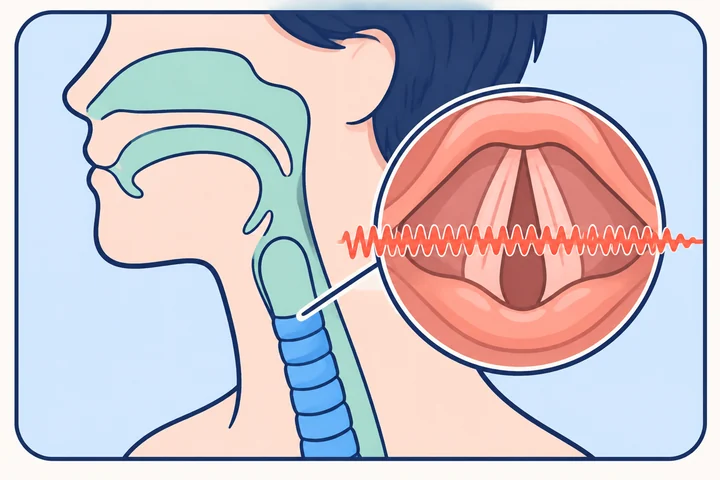
First, decide which you want
Some people searching “how to vocal fry” want to learn it, for singing, voice acting or metal. If that is you, head to vocal fry in singing or fry scream. This page is for the opposite goal: using less fry when you speak, because your voice tires, you are hard to hear on calls, or you simply do not like how it sounds on recordings. Whether fry is harmful is a separate question; the experts disagree, and we lay that out on is vocal fry bad?
How to tell if you have vocal fry: 4 signals
You cannot hear yourself accurately while you talk, so record. Read a paragraph aloud, then answer a question off the cuff (“what did you do last weekend?”). Play it back and listen for:
- The last two or three words of each sentence. Do they break into a low rattle?
- Your lowest, most relaxed moments. Fry shows up when pitch drops to the floor of your range.
- “Thinking” answers. Many people fry while they search for words.
- How often. Fry at the end of a long sentence is normal. Fry at the end of most sentences is a habit worth practising away if it bothers you.
Not sure what you are listening for? Compare your recording with this pair from the 2014 PLOS ONE study, same speaker, same sentence:
Normal voice
Vocal fry
Speaker 3 stimuli, Anderson et al. (2014), PLOS ONE, via Wikimedia Commons, CC BY 4.0.
3 fixes you can try today
1. Keep the air on until the last word
Fry creeps in when breath runs out. Before a long sentence, take an easy breath; as you speak, imagine the last word needs as much air as the first. ASHA’s speech-language pathologist demonstrates this in the video below with “Today is Tuesday”: the sentence ends on full voice instead of collapsing. Expressable gives the same advice: keep airflow steady through the end of the phrase.
2. Lift the pitch a little and bring it forward
If you habitually speak at the bottom of your range, there is nowhere to go but fry. Try speaking two or three notes higher, and aim the sound at your front teeth or the bridge of your nose, the “forward focus” University of Utah Health describes as the opposite of fry’s backward-focused voice. Do not push into a squeaky voice; a small lift is enough.
3. Look after the instrument
Hydrate, rest your voice after long calls, and swap throat clearing for a sip of water or a swallow. Expressable also lists managing acid reflux, which irritates the larynx. None of these stops fry directly, but a tired, dry voice drops into fry more easily.
A 7-day practice plan (5 minutes a day)
This combines the four exercise types Expressable recommends (breathing, humming, lip trills and straw phonation) into a short daily routine. It is a practice plan, not a treatment protocol.
| Day | 5-minute exercise | What you are aiming for | Common mistake |
|---|---|---|---|
| 1 | Breathing: 5 slow breaths low in the belly, then count to 10 on one breath | Feel steady airflow before you add voice | Lifting the shoulders |
| 2 | Humming on a comfortable note, 5 × 5 seconds, then glide up and down | A buzzy, forward sensation around the lips and nose | Humming too low, which slips into fry |
| 3 | Lip trills (“brrr”) across your range, 2 minutes | Even airflow; the lips keep trilling | Pushing air so hard the trill stops |
| 4 | Straw phonation: hum through a straw, then through a straw into water | Easy voice with gentle back-pressure | Clenching the jaw |
| 5 | Read 10 short sentences, keeping the last word as loud as the first | Sentence endings with full sound | Getting louder overall instead of sustaining the end |
| 6 | Same 10 sentences, starting two or three notes higher | A pitch where the end does not crack into fry | Going so high it feels strained |
| 7 | Record a 1-minute unscripted answer and compare with day 1 | Fewer sentence endings in fry | Expecting zero fry |
Common mistakes
- Pressing down on the larynx to sound deeper or more authoritative. That is the fastest route back into fry.
- Swapping fry for breathy or falsetto voice. Replacing one strain with another does not help.
- Constant throat clearing. It bangs the folds together; University of Utah Health and Expressable both flag it.
- Getting louder instead of sustaining. Shouting the end of a sentence is not the same as supporting it, and ASHA warns that pushing volume while holding fry is where problems start.
When it is not a habit
If your voice is hoarse for more than two to four weeks, hurts, or changed suddenly, practise less and get checked: see a voice-specialised speech-language pathologist or an ENT doctor. The full list is on the red-flags section.
Watch the sentence-ending technique
General information only; it cannot replace an evaluation by a speech-language pathologist or ENT doctor.