The terminology matrix
One table, so you do not have to open six tabs. The last-but-one column is the part most people are looking for.
| Term | Who uses it | What it refers to | Note | vs vocal fry | Sources |
|---|---|---|---|---|---|
| vocal fry | Media, voice teachers, everyday speech | The lowest register; low pulses, often at sentence end | The term this site is named after | Same thing | Wikipedia; Merriam-Webster |
| glottal fry | Speech-language pathologists | The same register, named for the glottis | In print since 1942 | Same thing | ASHA Leader; Vocabulary.com |
| creaky voice / creak | Phoneticians, linguists | A phonation type; can carry meaning in some languages | Firth used it in 1937 | Same thing (wider in some papers) | Wikipedia; Chinese Wikipedia |
| pulse register | Voice science | The pulse-by-pulse vibration pattern | Register model of the voice | Same thing | Wikipedia |
| laryngealization | Linguistics | The process of making a vowel or consonant creaky | Often used for languages | Same family | Wikipedia |
| harsh voice {V!} | Phonetics (VoQS chart) | Rough, strained, irregular voicing | Ventricular-fold voice is coded separately | Different | VoQS |
| death growl | Metal vocalists | A guttural, low distorted singing sound | Extended vocal technique | Different | Wikipedia |
| fry scream | Metal and hardcore | Bright, static-like distortion built on fry | Needs less air pressure than false-cord screams | Related, not the same | Extreme Vocal Institute |
Creaky voice vs vocal fry: same sound, different tradition
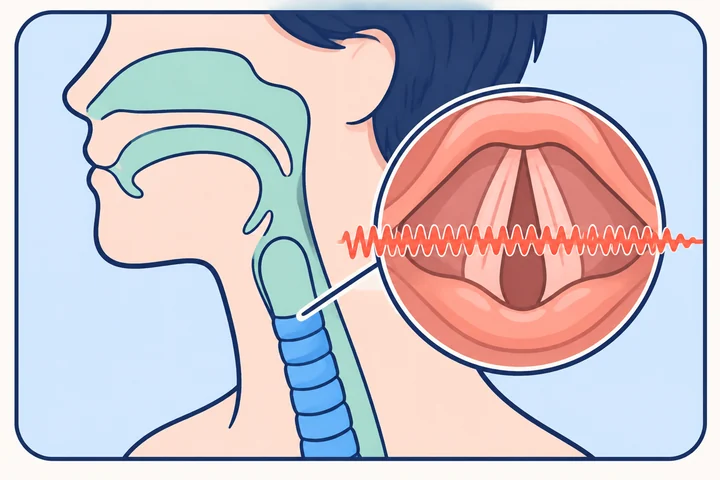
Wikipedia’s articles on both terms describe the same thing: the arytenoid cartilages pull together, the vocal folds are compressed but slack, and they vibrate irregularly at a very low rate. The 2016 ASHA Leader feature says the split is professional habit: speech-language pathologists tend to say glottal fry, linguists tend to say creaky voice.
Where the two words do drift apart is scope. Some phoneticians use “creaky voice” for any irregular, low-frequency phonation, including the kind that marks meaning in languages such as Danish (stød) or Jalapa Mazatec, while “vocal fry” in English mostly refers to the sentence-final habit. If you are reading a phonetics paper, treat creaky voice as the umbrella; in everyday English, treat them as synonyms. More on that on vocal fry in other languages.
What all four terms describe
Public-domain sample, “Vocal Fry.ogg”, Wikimedia Commons (CC0).
Glottal fry: the clinician’s word
“Glottal fry” is the older clinical term. Vocabulary.com traces its first publication to a two-page 1942 article by Henry M. Moser in the Journal of Speech Disorders; “vocal fry” followed in clinical writing in 1958. If your speech-language pathologist says glottal fry, they mean exactly what your friend means by vocal fry.
Pulse register and laryngealization
Voice scientists describe the voice in registers. In that model, fry is the pulse register, the bottom one, below modal (speaking) voice and far below falsetto. “Laryngealization” is the linguist’s word for adding this quality to a sound, so a “laryngealized vowel” is a vowel said in creaky voice. The IPA marks it with a tilde under the letter, as in [a̰]; see how to write vocal fry.
Harsh voice is not vocal fry
People search “harsh voice quality vs glottal fry” because both sound rough. The Voice Quality Symbols (VoQS) chart, the extension of the IPA used for disordered and atypical voices, gives them different codes: harsh voice is {V!}, creaky voice is {V̰} and creak alone is {C}. VoQS also separates harshness of the true vocal folds from voice made with the ventricular (false) folds. In practice: harsh voice is strained and noisy at any pitch; fry is low, loose and pulsed. A clinical definition of “harsh voice quality” beyond the VoQS chart is something we have yet to find in a source we could cite.
Growl and fry scream are performance techniques
Death growl and fry scream are ways of singing, not registers you drift into at the end of a sentence. Wikipedia describes the death growl as a guttural, low singing style used in death metal. Fry scream, according to the Extreme Vocal Institute, builds a bright, TV-static distortion on top of fry and needs less air pressure than a false-cord scream. We compare them properly on fry scream vs vocal fry.
Squall, buzziness, croak
Three more words show up next to vocal fry in searches. “Croak” appears in Wikipedia’s list of synonyms for the fry register and in country singing, where it describes starting a phrase in fry and sliding up. “Squall” and “buzziness” are used in singing communities, but neither has a definition we could pin to a reliable source, so we leave them out of the matrix instead of inventing one.