Three ways to write vocal fry
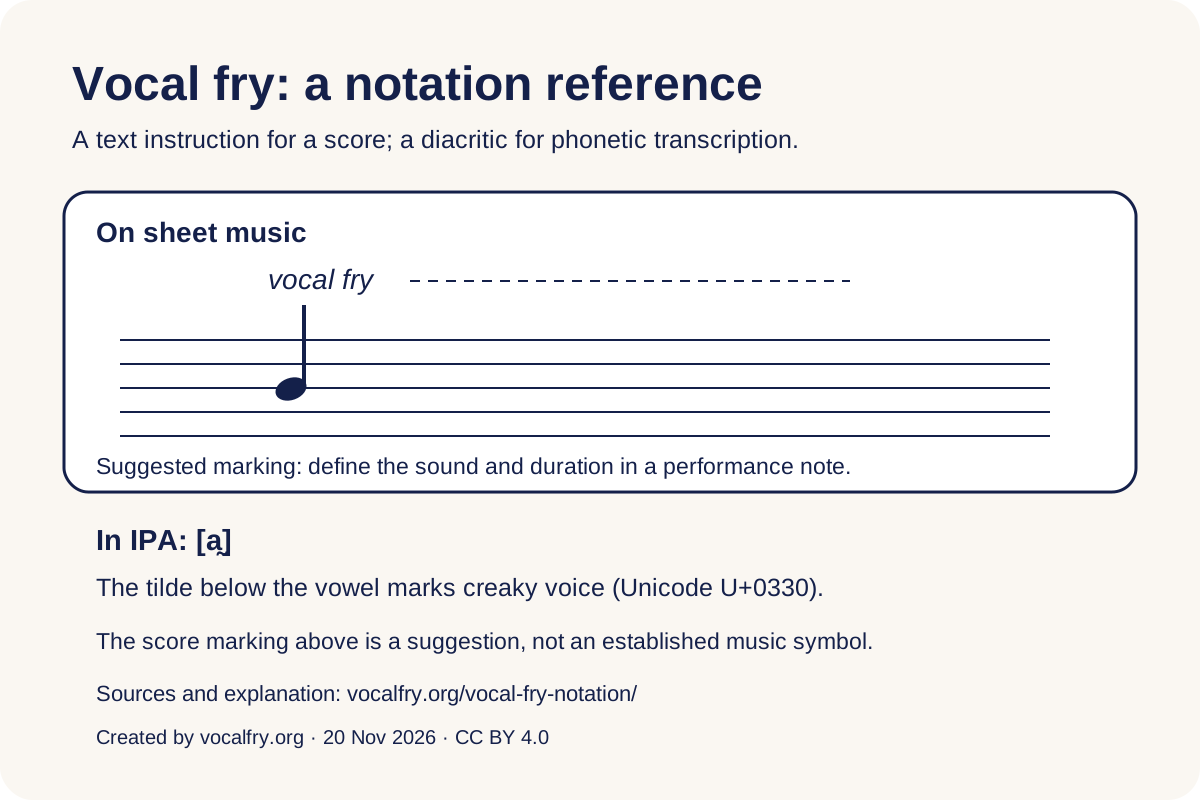
Download the notation reference card (SVG) for the suggested score marking and IPA diacritic. The card is an original illustration by vocalfry.org, available under CC BY 4.0.
1. On sheet music: a text instruction
For a choir part or a song chart, write fry (or vocal fry) in italics above the note or phrase, the way you would write breathy or falsetto. If the effect is a short onset, as pop and country singers use it, mark only the first note; if it should last, add a dashed extension line to show where it ends. Put a one-line explanation in the performance notes so every singer reads the marking the same way. This is our recommended practice, not a published standard; we found no symbol for fry in the standard lists of musical notation.
2. In phonetic transcription: the IPA diacritic
The International Phonetic Alphabet marks creaky voice with a tilde placed under a letter, Unicode U+0330 (combining tilde below). A creaky [a] is written [a̰], a creaky [d] is [d̰]. Wikipedia’s creaky-voice article uses this convention; it is the right choice for linguistics work or for a lyric sheet where you want to mark exactly which vowel creaks.
3. For whole stretches of speech: VoQS
The Voice Quality Symbols (VoQS) extend the IPA for voice qualities that last across a phrase. You wrap the stretch in curly braces with the symbol, and you can add 1, 2 or 3 for degree. For example, a sentence in moderate creaky voice would be marked with {V̰ at the start and V̰} at the end.
| Symbol | Name | Meaning |
|---|---|---|
{C} | Creak | Creak on its own, without normal voicing |
{V̰} | Creaky voice | Normal voicing mixed with creak |
{C!} | Harsh creak | Creak with added harshness |
{V!} | Harsh voice | Not fry: rough, strained voicing (listed for contrast) |
What vocal fry looks like on a spectrogram
A spectrogram plots time left to right, frequency bottom to top, and loudness as brightness. Normal voice shows smooth horizontal bands (the harmonics). Fry looks different: a row of separate vertical stripes, each one a single burst of air through the vocal folds, spaced unevenly. That is the visual version of what you hear as a rattle rather than a pitch, and it is why the National Center for Voice and Speech describes very low rates as being heard as individual pulses.
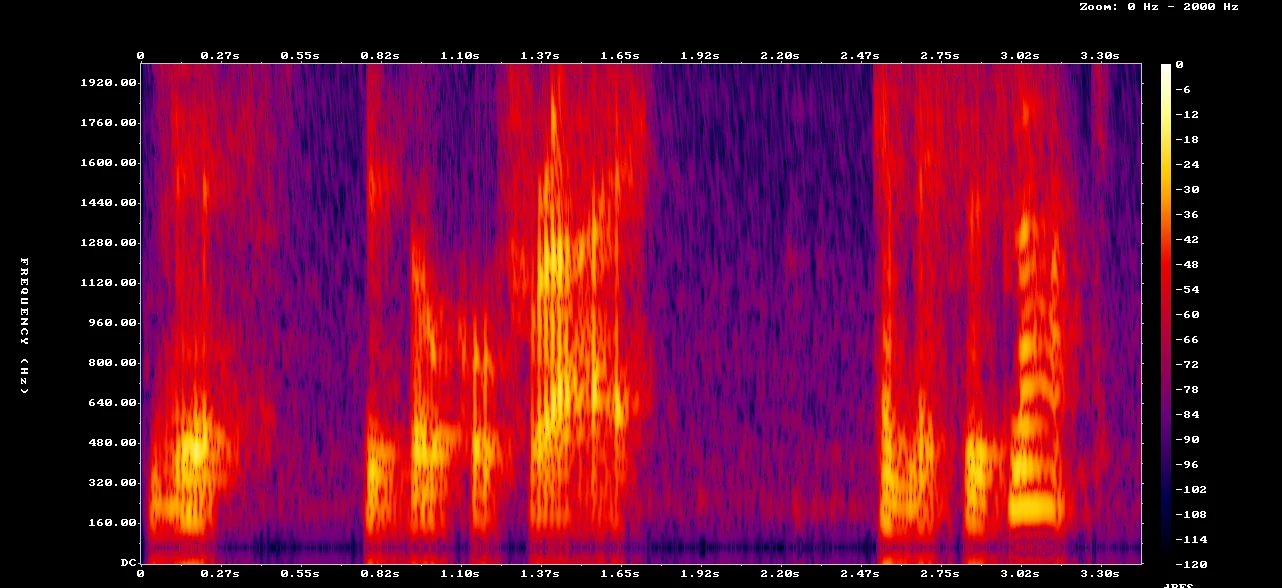
The sample in the spectrogram
“Vocal Fry.ogg”, Wikimedia Commons, CC0.
How to read it: look at the bottom third of the image. Count the stripes across one second and you get the pulse rate, roughly 20 to 50 per second in most sources, though some give wider ranges (see the definition page).
And on a waveform
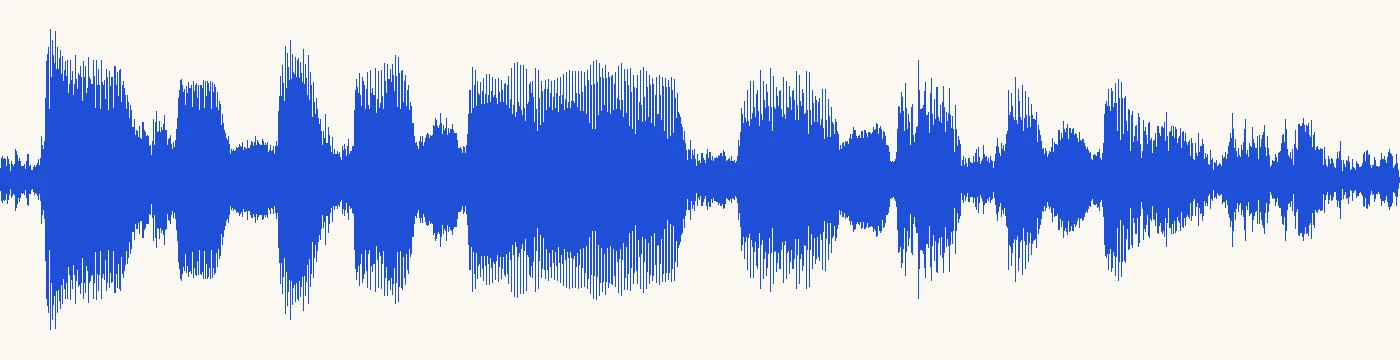
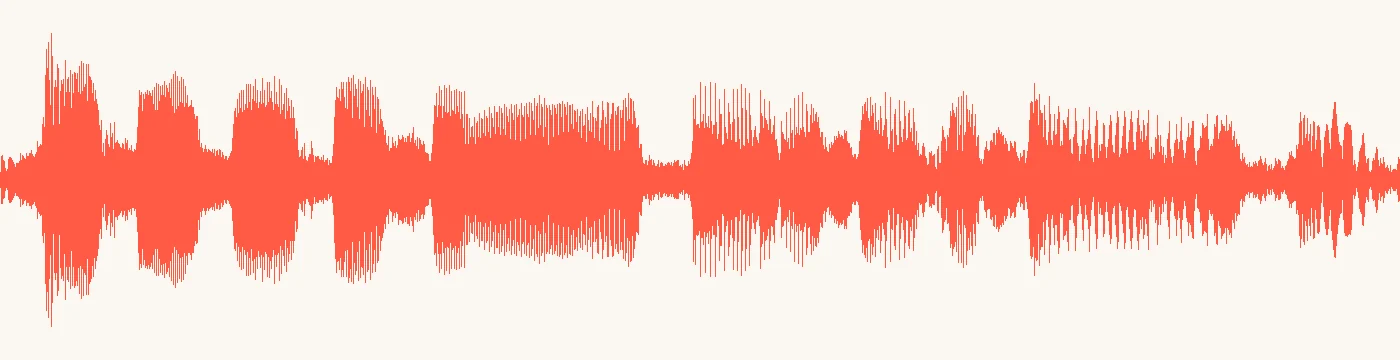
On a plain waveform, fry looks like a comb of spikes with gaps between them, compared with the dense, continuous band of normal voice. The two waveforms below come from the same speaker reading the same sentence.