Where the experts disagree
We give each source its own row instead of averaging them into one verdict, because the disagreement is the honest answer. Read the “key caveat” column: it often matters more than the headline.
| Source | Position | What it says | Key caveat |
|---|---|---|---|
| Johns Hopkins Medicine | Not harmful | Vocal fry is not physically harmful to the health of your voice, though it can become a habit. | If roughness lasts or gets in the way of communication, have the voice checked to rule out a fold lesion. |
| ASHA Leader (2016) | No evidence of injury | There is no evidence that glottal fry, in and of itself, causes injury. A 2011 study only suggested possible harm and did not test it. | Long or excessive use may tire and tense the larynx; pushing volume while holding fry is more likely to cause secondary problems. |
| NCVS (2026) | Not recommended for speech | No voice pathology is specifically tied to fry, apart from possibly unnecessary squeezing of the folds (hyperadduction). | The advice against fry is about being heard and understood, not proven tissue damage. Clinical opinion is described as mixed. |
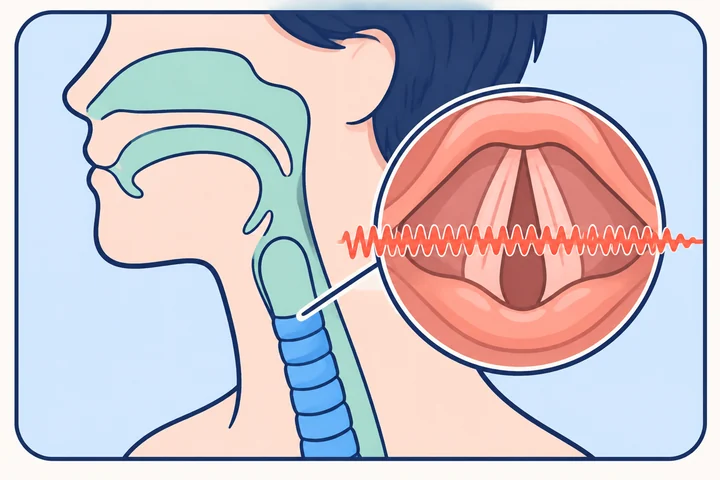
| Mayo Clinic (2017) | May be bad | Frequent fry may be bad: the back of the folds is squeezed while the front is slack, and theoretically that makes nodules or scars more likely. | The word is “theoretically”. This is a mechanism-based concern, not a result from long-term follow-up. |
| University of Utah Health (2016) | Possible fatigue and lesions | Heavy use may lead to vocal fatigue, pain when speaking, secondary lesions and neck-muscle tension; it calls fry a “backward-focused” voice. | Its description involves the ventricular (false) folds, which differs from the standard account. A clinical observation, not a trial. |
Two patterns stand out. First, the sources that say “harmless” and the ones that say “may be bad” are answering slightly different questions: whether fry itself injures tissue, versus whether a voice used mostly in fry, especially while pushing for volume, is under strain. Second, the clinical sources reviewed here do not report a long-term follow-up study counting nodules in heavy fry users. Mayo Clinic’s warning is explicitly theoretical, and ASHA points out that the most-quoted study suggesting harm never tested it.
What the research actually shows
- It is common and mostly sentence-final. A 2011 Long Island University study, reported by Science, found fry in more than two-thirds of 34 young women reading aloud, mostly at the ends of sentences, and rarely when they held a vowel. The authors read that as normal variation, unlikely to harm.
- Men do it too. Time reported a Centenary College study in which men used fry about 25% of the time and women about 10%; a 2025 McGill production study discussed in 2026 found more creak in men and older speakers in its bilingual sample. Neither looked at injury.
- Fry can be healthy or a symptom. A 2023 Applied Sciences paper notes fry occurs in healthy voices and can also signal a voice disorder; listeners mostly hear it from low pitch.
The research and the clinical sources agree on one thing: the risk, if any, comes from how you use your voice (squeezing, pushing volume, never resting) more than from the fry quality itself.
Reported side effects of heavy use
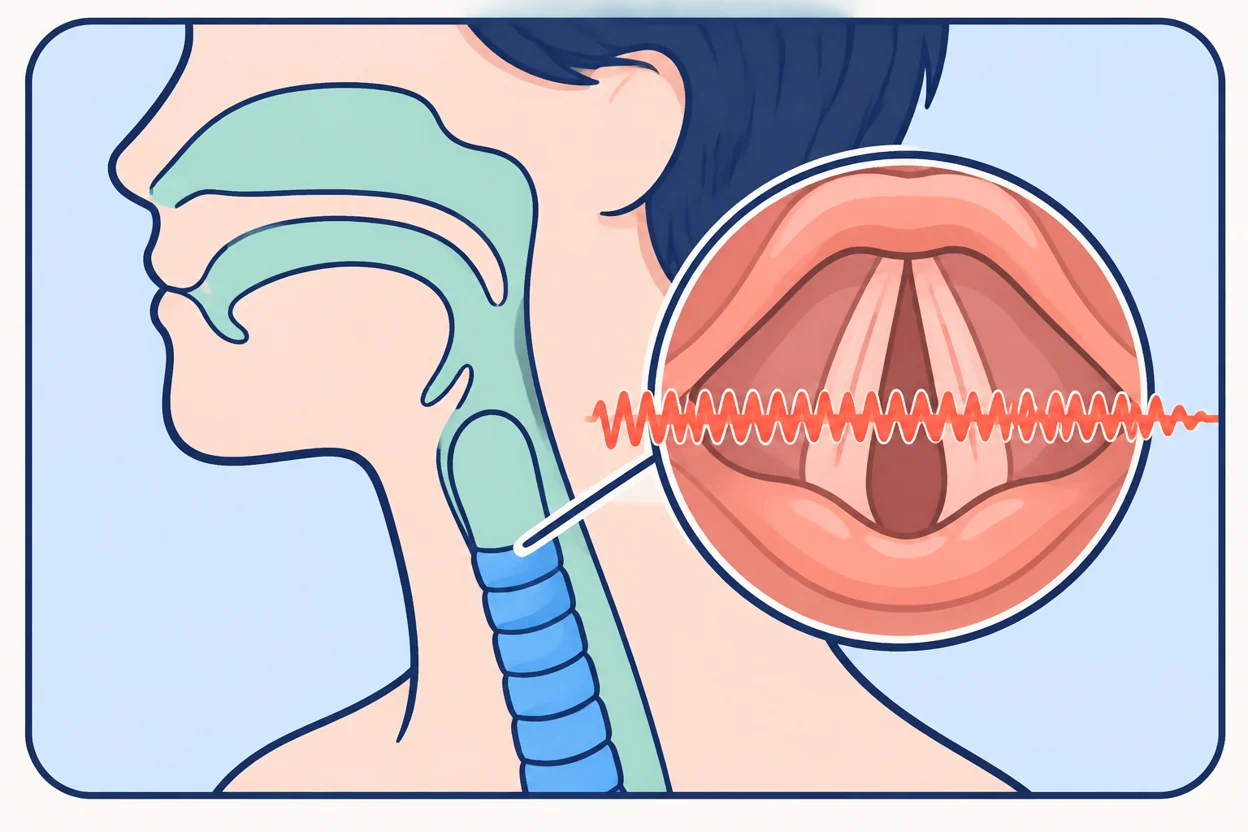
When sources do describe downsides, they are about heavy or forced use, not the occasional creak at the end of a sentence:
- Vocal fatigue and pain when speaking, plus tension in the neck muscles (University of Utah Health).
- Tension and tiredness in the larynx after long or excessive use (ASHA Leader, citing voice clinicians).
- Possible secondary lesions, such as nodules or scarring, described as a theoretical risk by Mayo Clinic and University of Utah Health.
- Being harder to hear and understand, which is the main reason the NCVS advises against fry for speech.
A sore throat can come with any of these, but it is not specific to fry; if it lasts, have it checked.
Red flags: when it is not about fry
These are reasons to book a voice check whether or not you use fry. They come from Johns Hopkins, University of Utah Health and Expressable:
- Hoarseness or roughness that lasts more than two to four weeks.
- Pain when speaking or swallowing.
- Your voice gives out by the end of the day, every day.
- A sudden change in your voice, or symptoms on one side.
- Trouble swallowing or breathing alongside voice changes.
Who to see
A speech-language pathologist (SLP) who specialises in voice can assess how you produce sound and teach easier habits. An ENT doctor (laryngologist) can look at the vocal folds directly with a scope to rule out nodules, polyps or other lesions. Many voice clinics pair the two. If your only concern is how fry sounds, an SLP is the usual first stop; if you have pain or lasting hoarseness, start with an ENT.
What you can do today
If you want to use less fry, the safest changes are the boring ones: keep air flowing to the end of the sentence, speak a touch higher and more forward, drink water, rest your voice and avoid constant throat clearing. Our how-to-stop page turns those into three quick fixes and a 7-day practice plan.
Mayo Clinic’s one-minute explainer
This is general information and cannot replace an evaluation by a speech-language pathologist or ENT doctor.