Hear it first
Definitions make more sense once your ear knows the target. This 3-second sample is nothing but fry: no words, just the pulses. Notice that you can almost count them.
Pure vocal fry, 3 seconds
“Vocal Fry.ogg”, Wikimedia Commons, released into the public domain (CC0).
For fry inside real speech, the home page plays one speaker saying the same sentence in her normal voice and then in fry, and the examples library has 28 more recordings, men and women, plus clips from TV, news and music.
The 10-second definition
Vocal fry is a way of producing voice, not a disease and not an accent. In the voice-science model of registers it sits below the modal register, which is your everyday speaking voice; falsetto sits at the other end. Wikipedia’s summary, which matches Johns Hopkins Medicine and Merriam-Webster, is that fry is the lowest vocal register, produced through a loose glottal closure that lets air bubble through slowly with a popping or rattling sound of very low frequency.
It goes by many names. These all point to the same thing, though each field has its favourite:
| Term | Who tends to use it | What it stresses |
|---|---|---|
| vocal fry | Media, voice teachers, everyday speech | The sizzling, “frying” sound |
| glottal fry | Speech-language pathologists | Where it happens: the glottis |
| creaky voice, creak | Phoneticians and linguists | A phonation type that some languages use to tell words apart |
| pulse register, pulse phonation | Voice science | The pulse-by-pulse vibration |
| laryngealization | Linguistics | The process of making a sound “creaky” |
| glottal rattle, glottal scrape, popcorning | Older and informal sources | The texture of the sound |
Some writers draw finer lines between creaky voice and fry. We lay those out on vocal fry vs creaky voice, together with harsh voice, growl and fry scream, which are genuinely different.
What happens in your larynx when you fry
Three things change compared with your normal voice:
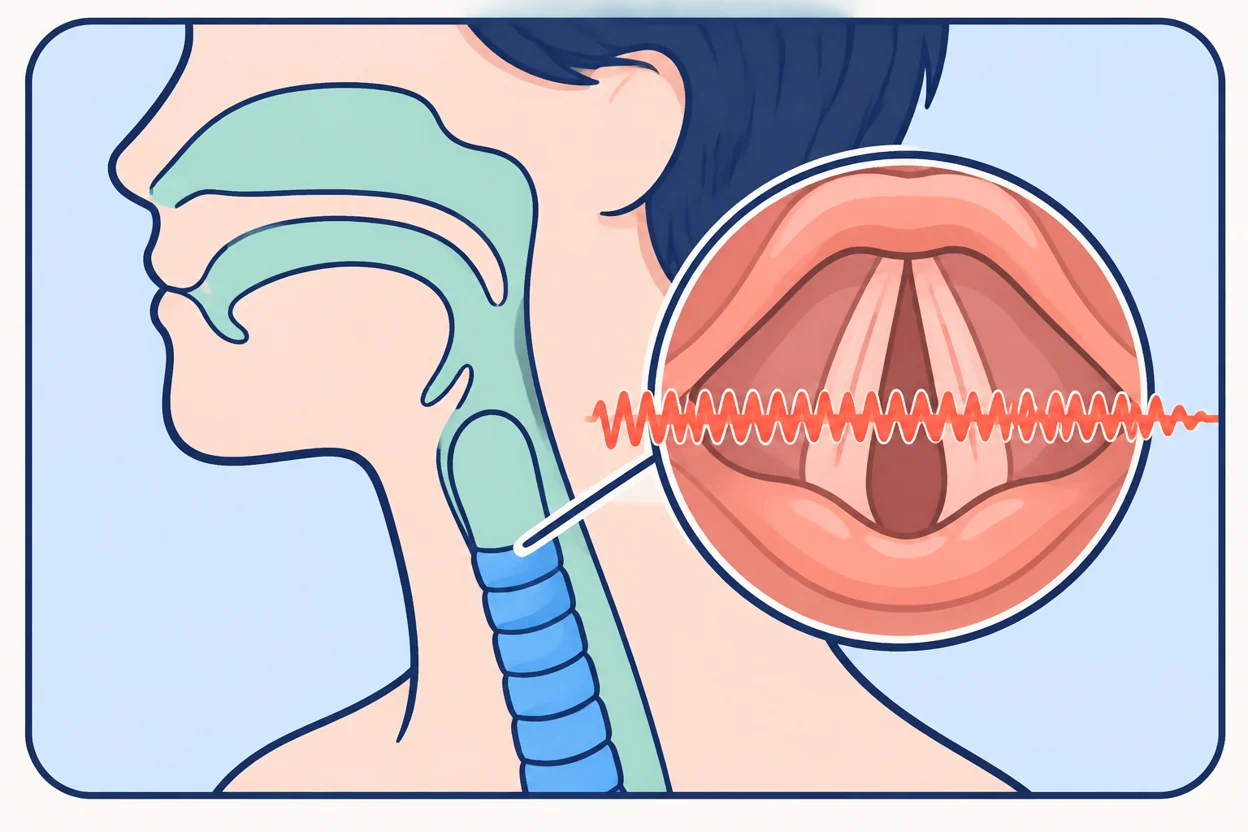
- The back of the folds is held together. The arytenoid cartilages, which steer the back ends of the vocal folds, draw in so the folds are pressed closed.
- The folds go slack, short and thick. The muscles that stretch the folds relax, so the folds behave like a heavy, floppy mass instead of a tight string.
- Air moves very slowly. Pressure builds until the folds pop open, a puff escapes, and they snap shut again. Each puff is one pulse you hear.
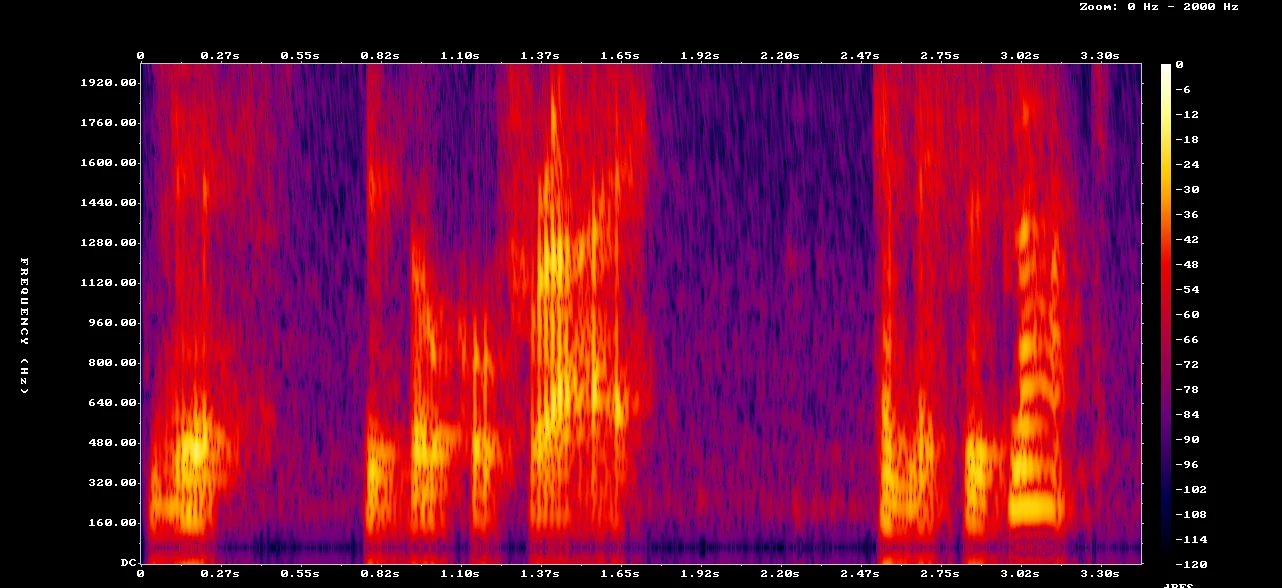
How many pulses per second? The sources do not agree, so we show all three figures rather than invent an average. Wikipedia gives roughly 20 to 50 pulses per second, about two octaves below normal voicing. A Korean vocal-coaching source gives 20 to 80, against 80 to 450 for the modal voice. The National Center for Voice and Speech describes anything below about 70 Hz as being heard as separate pulses rather than a pitch. The disagreement is mostly about where to draw a soft boundary, since the pulses are irregular anyway.
Why it lands at the end of sentences
When you finish a statement in English, your pitch falls and your breath runs low. Those are exactly the conditions that tip the folds into fry, so many speakers creak on the last word or two. Listeners use that creak as a cue that you have finished, the same way they use falling pitch. ASHA, Expressable and the NCVS all describe sentence-final position as the most common place for fry. Some people also fry through whole phrases, or whenever they speak at the very bottom of their range.
Is vocal fry normal?
Yes, in the sense that healthy voices do it. Voice scientists argued as early as 1966 that fry is a normal register, not automatically a disorder, and a 2016 ASHA Leader feature reports that there is no evidence glottal fry, in and of itself, causes injury. Whether it is good for you to use it all day is a separate question, and the experts split on that one. We put their positions side by side on is vocal fry bad? A quick triage:
- Fry at the ends of sentences, no pain, voice otherwise clear: common and generally considered harmless.
- You fry and your voice tires by evening: worth trying the three fixes and the 7-day plan.
- Hoarseness that lasts more than two to four weeks, pain, or a sudden change: see a speech-language pathologist or ENT doctor. That is about your voice, not about fry.
What people mean by “vocal fry theory”
There is no single scientific theory with that name. Searches for it usually want one of two things: the mechanism described above, or the debate about why fry is judged harshly, especially in young women. The second is covered on why vocal fry annoys people.
Where the term comes from
“Creaky voice” appeared in J. R. Firth’s 1937 book The Tongues of Men; “glottal fry” was in print by 1942; “vocal fry” entered clinical writing in 1958, and Merriam-Webster dates its first known use to 1963. The full timeline, including why “vocal fry 1937” is a word history and not a recording, is on the history page.